


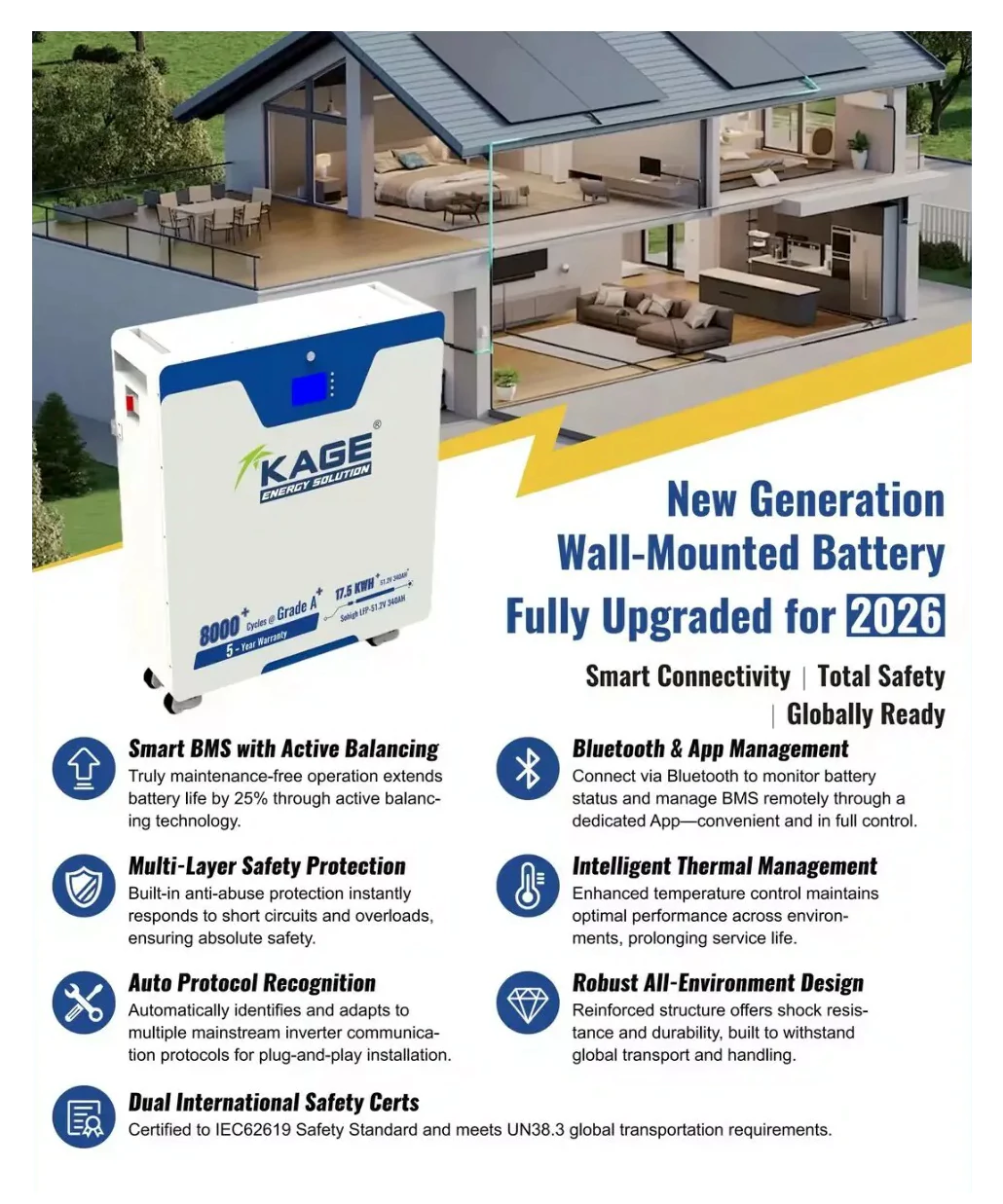
1.Detailed Explanation of Active Balancing Technology
Traditional passive balancing can only discharge overcharged cells, dissipating energy in the form of heat. In contrast,our active balancing technology acts as a precise "energy dispatcher" enabling active energy transfer between cells-directly shifting energy from high-charge cells to low-charge ones. This not only avoids energy waste but fundamentally improves the consistency of the entirebattery pack.The result is the maximization of each cell's potential,extending the overall cycle life of the battery pack by over 25% and truly delivering "maintenance-free" operation for end-users.
With an active balancing current of l A,voltage differences between cells can be controlled within 50 mv. Under cycling conditions of 0.5C,25°C, and 80% DOD,the measured cycle number to maintain≥80% capacity retention ranges from 6,000 to 8,000 cycles (varying by model).
2.High-Precision SOC Calibration and Data Traceability
Battery level display is no longer merely an "approximation." Thanks to upgraded algorithms and calibration procedures. the SOC estimation now employs more precise calculation methods, achieving an error margin of ≤3% under laboratory conditions (25°C,0.5C),allowing you to "know exactly" the remaining power.
More importantly, the fully upgraded log data recording system acts like a "black box" for the battery.With an 8 MB circular log,it records voltage,temperature, current, and fault codes.Data can be retrieved via Bluetooth 5.0 and exported as CSV files through the app for after-sales analysis.
1.Millisecond-Level intelligent Protection Against Misuse:
System-Level Protection:8 monitoring including functions short-circuit,overcurrent, and overtemperature, with interruption time<100 ms。
In extreme misuse scenarios such as external short circuits and overloads,our protection mechanism achieves millisecond-level response. This is not simply circuit interruption,but intelligent recognition and multi-level response based on multidimensional data(voltage,current slope,temperature), which cuts off the faulty circuit while maximizing the availability of the remaining system.
2.Structural Optimization and Comprehensive Protection
Security begins with physical structure. We have comprehensively optimized the internal module layout, connection methods, and shell reinforcement ribs of the battery, significantly improving the impact and vibration resistance performance of the product. This ensures that the internal core components of the battery remain stable and reliable even during complex land, sea, and improper handling processes. Combined with optimized thermal management air ducts, a comprehensive safety defense line is formed from battery cells to systems, from static to dynamic.
The internal temperature difference of the whole machine is less than 5 ℃ (ambient temperature of 25 ° C, continuous charging and discharging at 1C).
Working temperature range: charging 0 ° C-60 ° C, discharging -20 ° C-60 ° C; Discharge at 0.5C in -10C environment, with a capacity retention rate>90%.
1.Adaptive Protocol Inverter Recognition
We have pre-set a communication protocol library for mainstream inverters in the market, with built-in CAN/RS485 interfaces, which can adapt to mainstream 3-12 kW single-phase/three-phase energy storage inverters in the market. During installation, the battery can automatically recognize and match the inverter model, eliminating complex protocol selection and parameter setting steps, achieving true "plug and play", greatly reducing the installation and debugging threshold.
2.Globally-0riented Reliable Design
The product follows global standards from the beginning of its design. Through strict IEC62619:2022 safety certification and simulating harsh transportation conditions such as high altitude and low voltage, temperature cycling, vibration, and impact in UN38.3 testing, we ensure safe and stable delivery of every kilowatt hour of electricity to any corner of the world.
The product design has a lifespan of 10 years (1 cycle per day), and the actual number of cycles is affected by usage temperature, rate, and DOD; LCOE needs to be calculated separately based on local peak valley price differences, subsidies, and installation costs.
| Model No. | LFP-WM-51.2-5KWh | LFP-WM-51.2-10KWh | LFP-WM-51.2-17.5KWh | LFP-WM-51.2-20KWh |
| Length | 440mm | 480mm | 620mm | 1042mm |
| Width | 220mm | 220mm | 220mm | 220mm |
| Height | 460mm | 645mm | 645mm | 685mm |
| Weight | About 45kg | About 82kg | About 117kg | About 153kg |
| Nominal Voltage | 51.2V | |||
| Nominal Capacity | 100Ah | 200Ah | 340Ah | 400Ah |
| Nominal Energy | 5120Wh | 10000Wh | 17500Wh | 20000Wh |
| Internal lmpedance | ≤ 50mΩ | |||
| Charge Voltage | 58.4V | |||
| Discharge Cut-off Voltage | 40V | |||
| Standard Charge Current | 50A | 100A | 100A | 100A |
| Max. Charge Current | 100A | 200A | 200A | 200A |
| Standard Discharge Current | 50A | 100A | 100A | 100A |
| Max. Discharge Current | 100A | 200A | 200A | 200A |
| Peak Discharge Current | 200A<5S | 300A<5S | 300A<5S | 300A<5S |
| Cyele Life | ≥6000 0.5C,25°C 80%DOD | ≥6000 0.5C,25°C 80%DOD | ≥8000 0.5C,25°C 80%DOD | ≥8000 0.5C,25°C 80%DOD |
| Operating Temperature | Charge :0°C~+60°C | |||
| Operating Temperature | Discharge:-20°C~+60°C | |||


